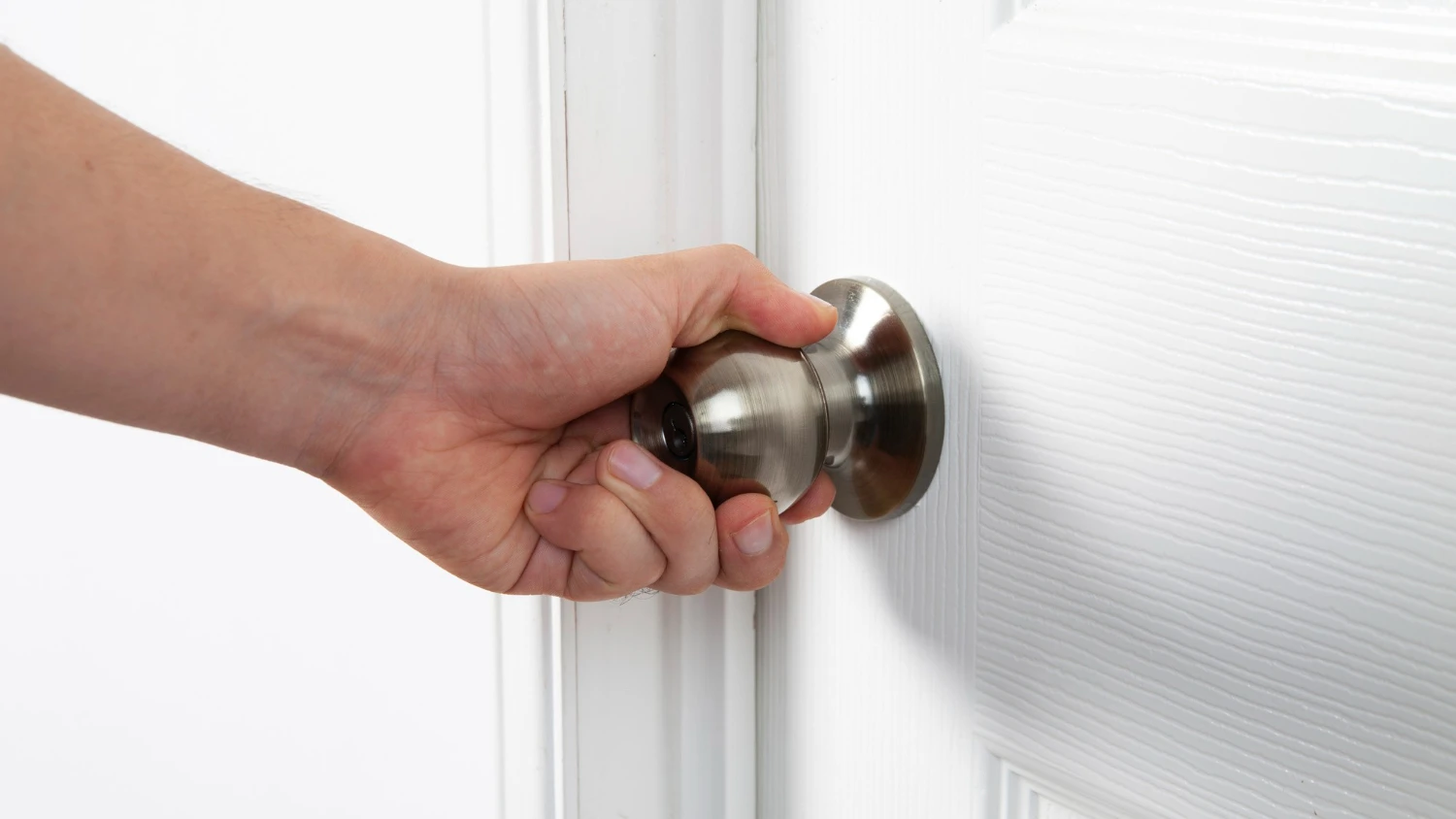
Door knob spins but won’t open is a door hardware problem that involves a free-spinning knob failing to engage the spindle and latch mechanism to achieve normal door opening.
In most homes, the fastest fix is to remove the inside knob or trim, inspect the spindle, set screw, and tubular latch, then either tighten the loose connection, replace the failed latch, or manually retract the latch with a flat screwdriver; if the door is shut and you cannot reach the mounting screws, your goal is to expose the latch hardware without forcing the knob.
In years of inspecting interior doors, entry doors, and rental-property hardware, the mistake I see most often is simple: homeowners keep twisting harder. That extra force rarely opens the door. It usually strips the connection even more and turns a cheap latch repair into a full door knob replacement.
Why a Door Knob Spins But Won’t Open
A spinning door knob almost always means the knob is no longer transferring motion to the latch bolt.
A standard cylindrical door knob works by rotating a spindle or internal hub that pulls back the latch. When that connection fails, the knob still turns in your hand, but the latch bolt stays extended in the strike plate. The result is frustrating. And very common.
The failure usually happens in one of these places:
- The set screw loosens and the knob disconnects from the spindle
- The spindle strips or slips out of the knob hub
- The tubular latch breaks internally
- The spring mechanism inside the knob body fails
- The privacy lock jams on a bathroom or bedroom door
- The trim plate or rose hides screws that you need to access before the knob can come apart
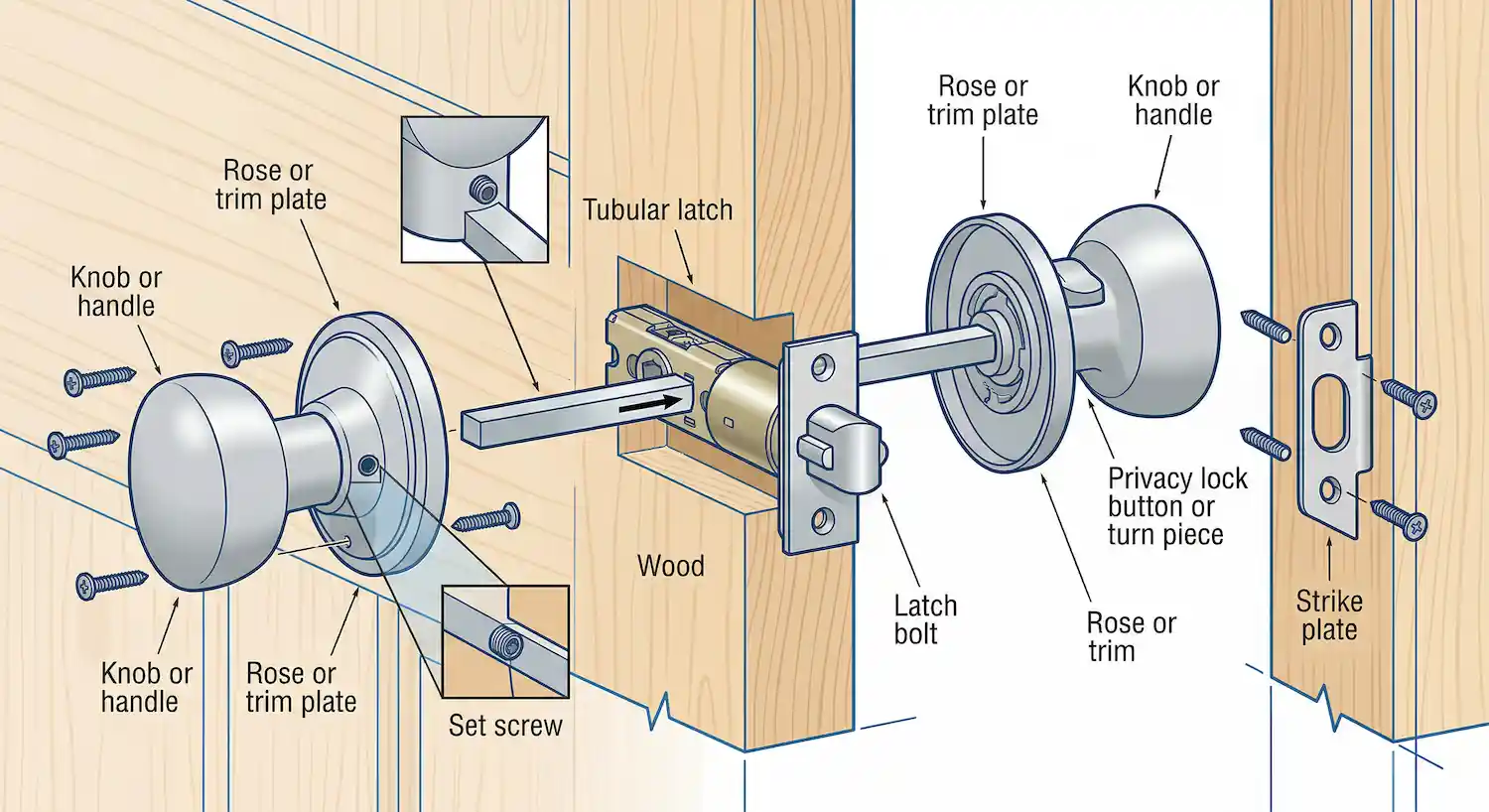
Door knob parts involved in a spinning knob problem
If you know the parts, the repair makes a lot more sense.
- Knob or handle: The part you grip and turn
- Spindle: The shaft that transfers turning motion from the knob to the latch
- Latch bolt: The spring-loaded bolt that retracts into the door edge
- Tubular latch: The assembly installed through the edge bore of the door
- Set screw: A small screw that secures the knob to the spindle or stem
- Rose or trim plate: The round cover that hides mounting screws
- Strike plate: The metal plate on the door jamb that receives the latch bolt
- Privacy lock button or turn piece: Common on bathroom door knobs
The most common root causes of a spinning door knob
- Loose set screw
- Common on older door knobs and some lever handles
- Usually the easiest fix
- Broken latch assembly
- Common on inexpensive interior hardware
- Usually means replacement is smarter than repair
- Stripped knob hub
- The inside of the knob rounds out and no longer grabs the spindle
- Often happens after repeated forcing
- Failed privacy lock
- Common on bathroom doors
- The lock button and latch can bind together
- Worn or misassembled door hardware
- Often appears after partial repairs, repainting, or loose screws
Door Knob Spins But Won’t Open: Causes and Fixes at a Glance
If you match the symptom to the failed part first, you can save time, avoid damage, and buy the right replacement hardware on the first trip.
| Symptom | Likely Door Hardware Failure | Best Fix | DIY Difficulty | Typical Time | Typical Part Cost |
|---|---|---|---|---|---|
| Knob spins freely both ways, latch does not move | Broken tubular latch or stripped hub | Replace latch or full knob set | Easy to Moderate | 20–45 min | $10–$35 |
| One knob spins, other side still has some resistance | Loose set screw or loose spindle connection | Tighten set screw, re-seat spindle | Easy | 10–20 min | $0–$10 |
| Bathroom privacy knob spins and lock won’t release | Jammed privacy mechanism | Remove trim, disengage lock, replace privacy latch | Moderate | 20–40 min | $15–$40 |
| Exterior keyed entry knob spins with door closed | Failed entry latch or stripped chassis | Disassemble from inside if possible; call locksmith if blocked | Moderate to Hard | 30–60 min | $25–$80 |
| Lever handle droops and spins | Broken return spring or internal chassis | Replace lever set | Easy to Moderate | 20–40 min | $20–$70 |
| Old door knob on vintage door spins loosely | Worn spindle, set screw, or mortise lock follower | Replace spindle or repair mortise lock | Moderate | 30–90 min | $10–$120 |
Safety Steps Before You Fix a Spinning Door Knob
Protect the door, the jamb, and your hands before you touch the hardware.
A spinning knob repair is usually safe, but sharp latch edges, slipping screwdrivers, and forced prying can scar the door fast. If this is an exterior entry door, slow down. Damage to the latch side of the slab or jamb costs much more than a new knob set.
Before you start:
- Make sure no child, elderly adult, or pet is trapped behind the door
- If the room contains a medical risk, water leak, or active hazard, treat the situation as urgent and call for help
- Do not kick the door unless it is a true emergency
- Avoid butter knives and improvised metal tools that slip easily
- If the door swings inward, check whether you can access the hinge pins
- If the door is part of a fire-rated assembly, use matching rated replacement hardware
Turn off the “force it” instinct
If the knob is spinning, extra twisting does not usually retract the latch. It just wears the parts more. Pulling, jerking, or prying can also split trim, bend the latch faceplate, or damage painted casing.
Tools for Door Knob Repair
Most spinning door knob repairs need only basic hand tools, not specialty locksmith equipment.
Keep these tools nearby:
- Phillips screwdriver
- Flat-head screwdriver
- Small Allen wrench set
- Needle-nose pliers
- Utility knife
- Flashlight
- Replacement tubular latch or door knob set
- Small container for screws
Optional but helpful:
- Putty knife
- Drill/driver
- Penetrating lubricant for rusty screws
- Tape to protect painted trim
- Replacement spindle for older door hardware
How to Open a Door When the Door Knob Spins But the Door Is Closed
When the door is shut, the goal is not to “fix” the knob first; the goal is to expose the latch mechanism so you can retract the latch bolt.
This is the situation most people care about. The room is closed. The knob turns uselessly. You need the door open without wrecking the slab.
If the inside door knob screws are visible
This is the easiest version.
- Stand on the side where the mounting screws are visible.
- Remove the two long screws that hold the interior and exterior halves together.
- Pull off the inside knob and then the outside knob.
- Remove the rose or trim if it is still attached.
- Once the chassis is exposed, use a flat screwdriver to turn the center hub or retract the latch mechanism.
- Open the door.
- Remove the latch from the door edge and inspect whether the tubular latch or spindle failed.
If the latch retracts with a screwdriver but not with the knob, the latch is often fine and the knob connection is the failed part. If the latch still will not retract, the latch body likely broke internally.
If the screws are hidden behind the trim plate
Many modern door knobs hide the screws under a decorative rose.
- Look for a small slot or release hole on the neck of the knob.
- Press the detent with a small screwdriver, paper clip, or awl.
- Pull the knob off the stem.
- Slip off or gently pry the rose cover.
- Remove the now-visible mounting screws.
- Expose the chassis and rotate the center opening with a flat screwdriver.
Use light pressure. A painted trim plate may need a light score with a utility knife first so the paint does not peel off the door surface.
If you can expose the latch from the door edge
Once the knob halves are off, remove the faceplate screws on the door edge. Pull the tubular latch out if it is loose enough. If the latch sticks in the bore, use pliers gently and wiggle it straight out.
Then:
- Insert a flat screwdriver into the latch opening
- Turn or push the internal actuator
- Retract the latch bolt manually
- Open the door
That bypasses the failed knob completely.
If the door opens inward and the hinges are accessible
Sometimes the knob hardware is too damaged to disassemble cleanly, but the hinge side is available.
- Check whether the hinge pins are removable.
- Tap the hinge pins upward with a nail set or small punch and hammer.
- Remove all hinge pins.
- Pull the hinge leaves apart and shift the door slab away from the jamb if there is enough clearance.
This method does not work on every door. Tight jamb margins, security hinges, or paint buildup may still hold the slab in place. Still, on some bathroom and bedroom doors, it is the cleanest way in.
When to stop and call a locksmith
Call a locksmith if any of these apply:
- The spinning knob is on an exterior entry door
- The door has a deadlatch plunger and will not credit-card open
- The knob hardware is concealed and inaccessible
- The door has a smart lock, mortise lock, or multi-point lock
- The latch is broken so badly that the door will not release after knob removal
- You are at risk of damaging a solid wood door, fiberglass door, or metal jamb
How to Fix a Door Knob That Spins When the Door Is Open
When the door is already open, repair becomes much easier because you can work on the latch and knob assembly without pressure or damage risk.
This is the best-case scenario. Test everything with the door open first. Never close the door until the latch retracts and releases smoothly several times.
Tighten a loose set screw on the door knob
A loose set screw is common on older knobs and some lever sets.
- Locate the set screw on the neck of the knob.
- Tighten it with the correct Allen wrench or flat screwdriver.
- Hold the opposite knob steady while tightening.
- Test the knob rotation.
- If the spindle still slips, remove the knob and inspect for stripped metal.
If the set screw will not tighten because the threads are worn, replacement is better than patching.
Re-seat or replace the spindle
Some door knobs use a square spindle. If the spindle slides out of position or rounds off, the knob spins without moving the latch.
- Remove the knob.
- Pull out the spindle.
- Inspect for wear, rounded corners, or cracks.
- Reinsert the spindle squarely into the latch follower.
- Reattach the knob and tighten all screws.
- Test the latch 5 to 10 times with the door open.
If the spindle is visibly worn, replace it. Spindles are inexpensive, especially for older interior hardware.
Replace a broken tubular latch
Tubular latches fail more often than people think. Springs snap. Internal tabs bend. Cheap stamped-metal parts wear down.
- Remove both knob halves.
- Unscrew the faceplate on the door edge.
- Pull out the old latch.
- Compare backset measurement, usually 2-3/8 inches or 2-3/4 inches in US doors.
- Install the new latch in the same orientation.
- Reattach the knob set.
- Test the latch before closing the door.
Check the bevel of the latch bolt. The angled side should face the strike plate so the door closes smoothly.
Replace the full cylindrical door knob set
If the knob hub is stripped or the hardware feels loose all over, replace the entire set.
- Buy a matching passage, privacy, or keyed entry knob
- Confirm the backset, cross bore, and latch type
- Remove old knob halves and latch
- Install new latch first
- Feed exterior knob through the latch opening
- Attach interior knob and tighten the mounting screws
- Align the strike plate if needed
- Test knob action, latch retraction, and lock function
In many cases, full replacement is faster than piecing together old parts.
How to Fix Specific Door Knob Problems
The right repair depends on whether you have a privacy knob, keyed entry knob, lever handle, or older mortise lock.
Not all spinning knobs fail the same way. Door type matters.
Privacy bathroom door knob spins but won’t open
Bathroom knobs often fail at the privacy lock button or the latch body.
Look for these signs:
- The emergency release hole does nothing
- The inside knob spins with very little resistance
- The privacy button feels loose or jammed
- The latch retracts halfway, then stops
Best fix:
- Remove the interior knob and trim
- Disengage the privacy mechanism
- Replace the privacy latch or the whole privacy knob set
Because bathroom hardware is inexpensive, replacement is usually the smart move.
Keyed entry door knob spins but won’t open
An entry knob carries more wear and more load. You also have weather, dirt, and repeated locking cycles.
Common failures include:
- Broken entry latch
- Worn chassis
- Stripped connection between knob and latch
- Misalignment caused by a swollen wood door and binding latch
If the door is closed and locked, do not force the key cylinder or pry the jamb unless it is an emergency. Entry door hardware is where a locksmith often earns the fee.
Door lever handle spins but won’t open
Lever handles often fail at the internal return spring or chassis cassette. The lever may droop, sag, or spin with no latch movement.
Best fix:
- Remove the lever by pressing the release tab
- Remove trim plate
- Inspect mounting screws and spring cassette
- Replace the lever set if the chassis is worn
Individual internal parts are not always sold separately for residential lever sets.
Old mortise lock door knob spins but won’t open
Vintage homes can have mortise locks instead of tubular latches. In that case, the knob may spin because the set screw, spindle, or mortise follower is worn.
Best fix:
- Remove the knob and spindle
- Inspect the mortise lock body inside the door
- Replace the spindle first if worn
- Repair or replace the mortise lock if the follower is stripped
Old-house hardware is worth preserving if the trim and knobs are original brass, bronze, or glass. But take photos before disassembly. Parts orientation matters.
Should You Repair the Latch or Replace the Entire Door Knob?
If the hardware is inexpensive, loose in several places, or more than lightly worn, replacing the full door knob set is usually the better value.
Repair makes sense when:
- The set screw is loose
- The spindle slipped out
- The latch is separate and easy to replace
- The knob finish matches other hardware you want to keep
Replacement makes sense when:
- The knob hub is stripped
- The latch and spring both feel weak
- The trim is bent
- The hardware is builder-grade and already aging
- You want better security, smoother operation, or a finish update
For many interior doors, a new passage or privacy knob costs less than the time spent chasing worn parts. For entry doors, buy a decent Grade 2 set if you want longer life.
Common Door Knob Repair Mistakes That Make the Problem Worse
Most failed DIY door knob repairs happen because the homeowner attacks the symptom instead of the latch mechanism.
Avoid these mistakes:
- Twisting the knob harder after it starts free-spinning
- Closing the door to “test it one more time” before the repair is complete
- Buying the wrong backset or latch type
- Installing the latch bolt backward
- Losing the long mounting screws
- Prying painted trim without scoring the paint line first
- Mixing passage hardware with privacy hardware
- Assuming WD-40 alone will fix a broken latch
Lubricant can help a sticky latch. Lubricant will not repair a stripped spindle or broken hub.
Door Knob Maintenance to Prevent Another Latch Failure
A little maintenance goes a long way because loose screws and dry latch parts are early warning signs of future door hardware failure.
Use this simple maintenance routine once or twice a year:
- Tighten visible mounting screws
- Check set screws on knobs and lever handles
- Test latch retraction with the door open
- Vacuum dust from the strike plate area
- Use a dry lubricant or lock-safe lubricant on moving parts
- Re-align the strike plate if the latch rubs
- Address door sag before the latch starts binding
Watch for these warning signs:
- Knob wobble
- Lever droop
- Sticky latch bolt
- Clicking without full retraction
- Lock button that does not pop back cleanly
Those small symptoms usually show up before a full spin-and-no-open failure.
When a Locksmith or Handyman Makes More Sense for a Spinning Door Knob
If the door is an exterior entry door, a vintage mortise lock door, or a shut door with concealed hardware, professional help may save money by preventing door and jamb damage.
In the US, you can expect rough ranges like these:
- Interior door knob replacement by a handyman: $75–$150
- Basic locksmith visit for a stuck residential knob: $90–$200
- Entry door lockset replacement with service call: $120–$300+
- Vintage mortise lock repair: varies widely, often higher because parts and labor are more specialized
Paying for service makes sense when the hardware is high-value, the door slab is expensive, or access is limited.
Frequently Asked Questions About a Door Knob That Spins But Won’t Open
Most homeowners have the same final questions: can the door be opened safely, is the latch broken, and is replacement cheaper than repair.
Why does my bathroom door knob spin but not unlatch?
A bathroom door knob usually spins without opening because the privacy latch or internal hub has failed. The lock button, spring, or latch actuator can disconnect from the knob, so the knob turns but the latch bolt stays extended.
Can I open a spinning door knob with a credit card?
Sometimes, but only if the door is not deadlatched and the latch bevel is accessible from the jamb side. A credit card trick does not repair the failed knob, and it often does nothing on modern entry hardware with a deadlatch plunger.
How much does it cost to fix a door knob that spins but won’t open?
If you do the work yourself, many interior door fixes cost $10 to $40 in parts. If you hire a locksmith or handyman, the total is often $75 to $200+, depending on door type, access, and whether you need full lockset replacement.
Should I repair a spinning door knob or replace the whole knob set?
If the problem is just a loose set screw or shifted spindle, repair is fine. If the latch, hub, spring, or chassis feels worn, replacing the entire knob set is usually faster, cleaner, and more dependable.