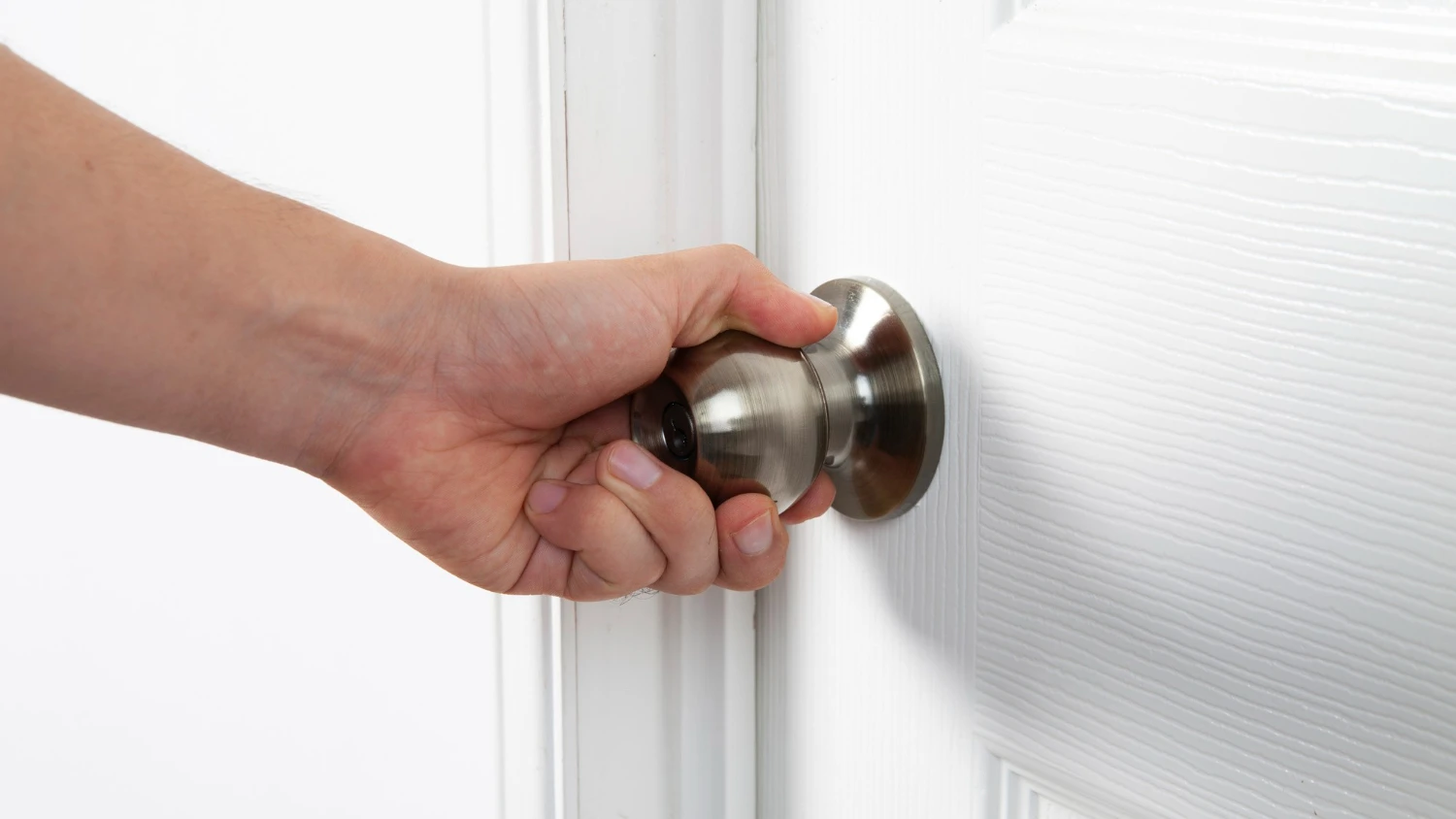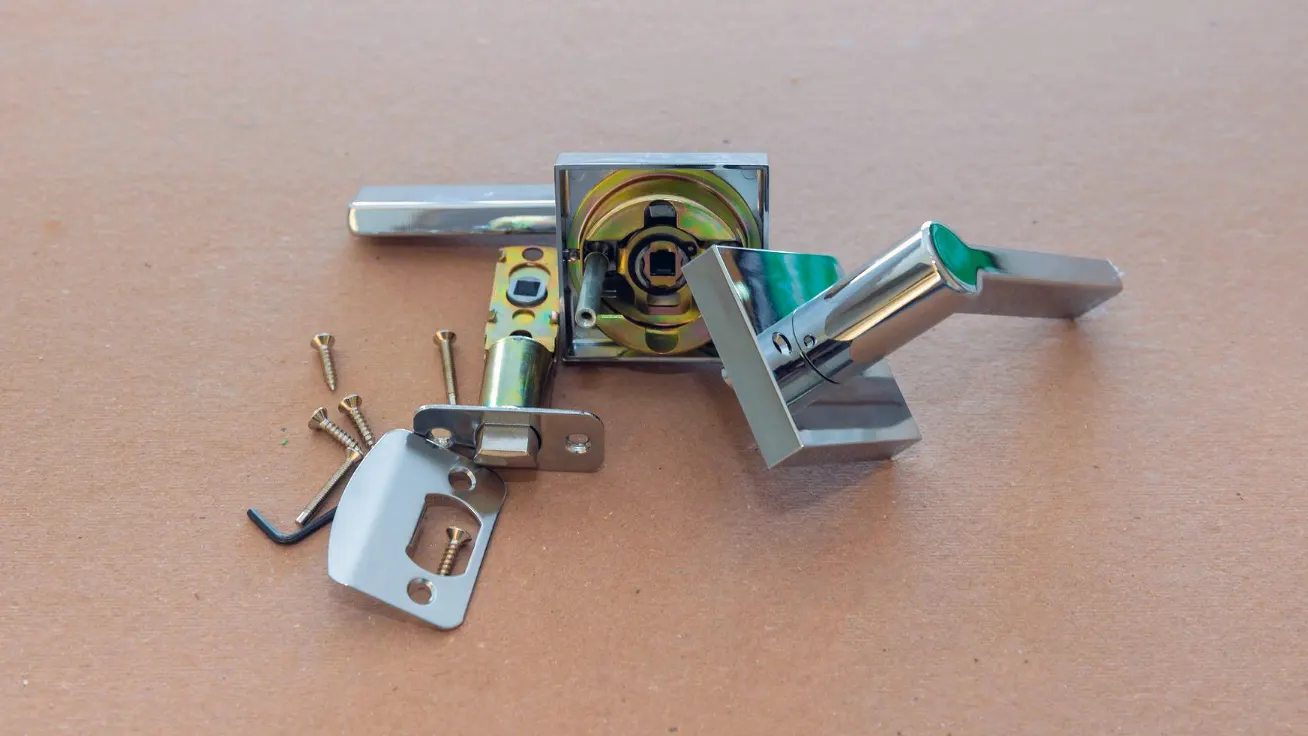
A deadbolt lock is a door security hardware assembly that involves a keyed or thumb-turn-operated bolt extending into a strike plate to achieve forced-entry resistance and controlled access.
If you want the fast answer, the deadbolt parts that matter most are the key cylinder, plug and pins, thumb turn, tailpiece, bolt, faceplate, strike plate, and mounting screws, because those parts decide whether your entry door locks smoothly, lines up with the frame, and stands up to prying, kicking, and wear.
In years of looking at entry doors and locksets, a common mistake I see homeowners make is blaming the key cylinder when the real problem is poor door alignment, a weak strike plate, or short screws in the jamb.
Deadbolt lock parts at a glance
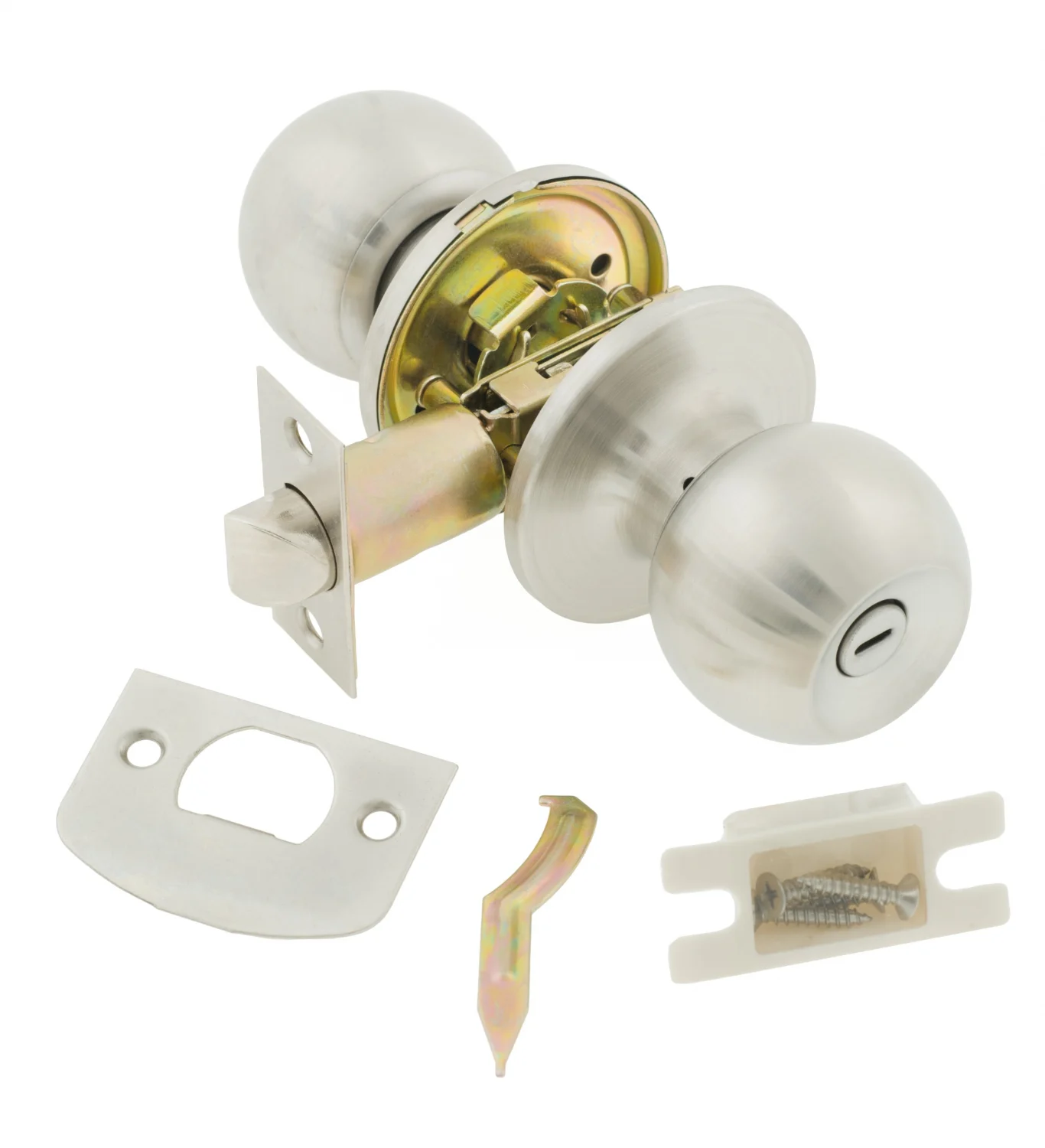
If you understand where each deadbolt part sits and what each deadbolt part does, you can diagnose most deadbolt problems in minutes.
A deadbolt lock is not just the shiny hardware you see on the door. A complete deadbolt system includes parts on the outside of the door, parts on the inside of the door, parts inside the door edge, and parts mounted to the door frame.
Here is the quick reference version.
| Deadbolt part | Location | What the deadbolt part does | Why the deadbolt part matters |
|---|---|---|---|
| Key cylinder | Exterior side of door | Accepts the key and turns the lock mechanism | Controls keyed entry and pick resistance |
| Plug and keyway | Inside the key cylinder | Matches the correct key shape and rotation path | Allows or blocks cylinder rotation |
| Pins and springs | Inside the key cylinder | Align at the shear line when the right key is inserted | Prevents unauthorized turning |
| Thumb turn | Interior side of door | Manually throws or retracts the bolt | Lets you lock or unlock without a key from inside |
| Tailpiece or cam | Connects cylinder/thumb turn to bolt mechanism | Transfers rotation to the deadbolt bolt | Makes the lock actually move |
| Deadbolt bolt | Extends from door edge into frame | Secures the door in the closed position | Provides the main physical barrier |
| Faceplate | Door edge | Covers and anchors the bolt assembly | Helps fit and stabilize the lock case |
| Strike plate | Door jamb | Receives the extended bolt | Supports security and alignment |
| Reinforcement box | Behind the strike plate in the frame | Spreads impact into the framing | Improves kick-in resistance |
| Through-bolts and screws | Interior and edge mounting points | Hold the lock together | Affect long-term stability and door fit |
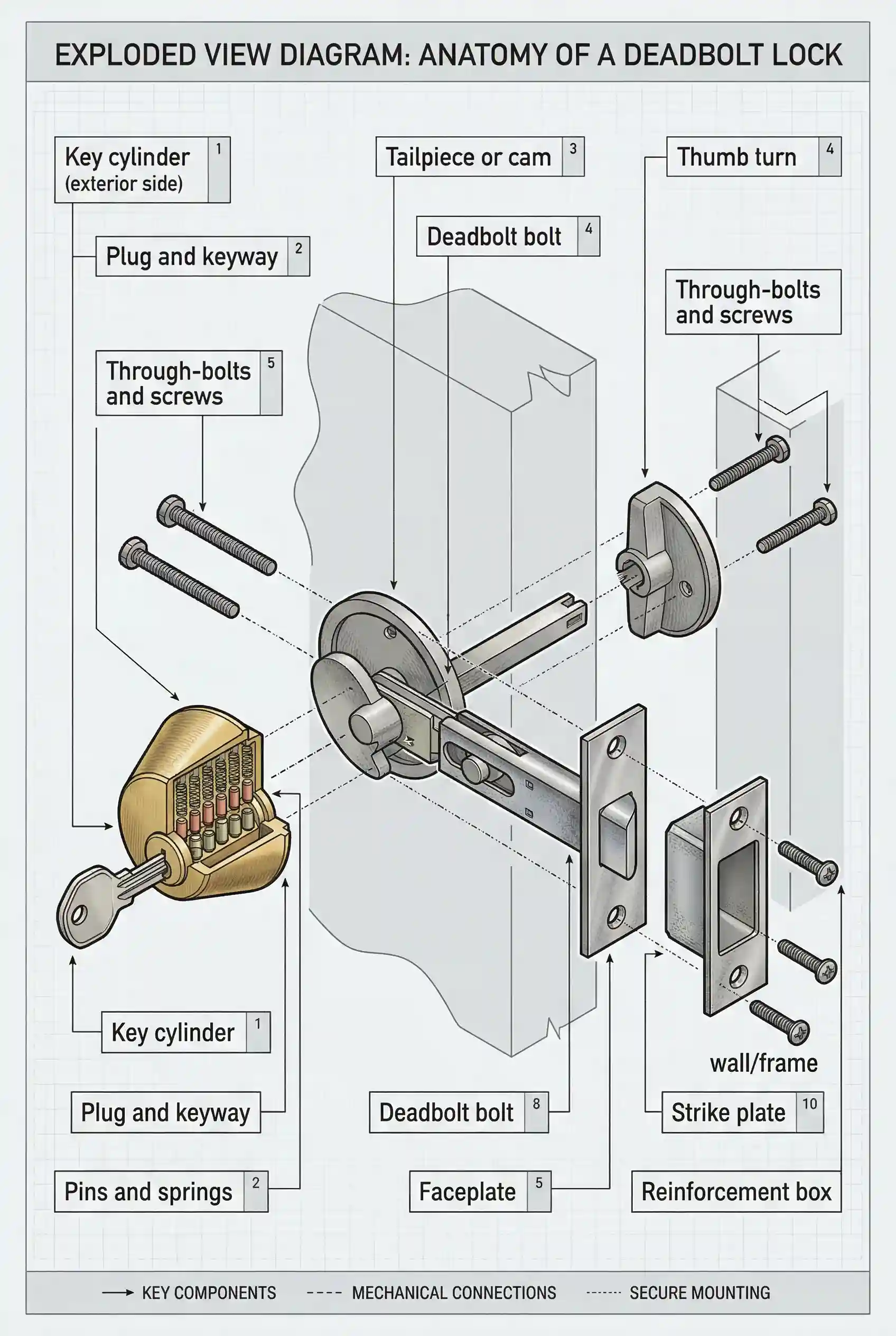
For most homeowners, that is the core map. The rest of the article explains how every part works, what fails first, and what you should replace when a deadbolt lock starts acting up.
Exterior deadbolt components
The exterior side of a deadbolt lock is where key control, pick resistance, and weather exposure all meet.
The outside half of the deadbolt is what most people picture first. That exterior assembly usually includes the key cylinder, cylinder housing, trim ring or escutcheon, and part of the linkage that connects to the bolt inside the door.
Key cylinder
The key cylinder is the part that accepts your house key. On a single-cylinder deadbolt, the key cylinder is only on the exterior side. On a double-cylinder deadbolt, a key cylinder is installed on both sides.
A good key cylinder should turn smoothly without slop. If the key cylinder feels gritty, binds, or needs wiggling, the issue may be worn pins, dirt in the keyway, a bent key, or a misaligned bolt.
Plug and keyway
The plug is the rotating core inside the cylinder. The keyway is the shaped slot cut into the plug where your key slides in.
When you insert the correct key, the cut pattern on the key lifts the pins to the right height so the plug can rotate. If the wrong key goes in, the pins stop the plug from turning.
Pins, springs, and shear line
Most residential deadbolts in the US use a pin tumbler cylinder. Inside that cylinder, you will usually find:
- Key pins
- Driver pins
- Small springs
- A shear line between the plug and the cylinder housing
When the right key lifts the key pins and driver pins so they line up at the shear line, the plug rotates. That is the heart of keyed operation. No mystery. Just precision.
Cylinder housing and exterior trim
The cylinder housing surrounds the plug and pins. The exterior trim, sometimes called an escutcheon, is the visible metal cover on the outside face of the door.
The exterior trim does more than look finished. A sturdy trim plate helps protect the cylinder opening, supports weather resistance, and helps the deadbolt sit flat against the door surface.
Security features you may see on better deadbolts
Higher-grade deadbolts often include extra cylinder protections such as:
- Anti-pick pin designs
- Drill-resistant inserts
- Hardened steel components
- Restricted keyways
- Bump-resistant pin arrangements
If you live in an area where porch theft, break-in attempts, or rental turnover are common, these details are worth paying attention to.
Interior deadbolt components
The interior side of a deadbolt lock controls everyday convenience, but the interior hardware also affects security, alignment, and durability.
The inside half of the deadbolt usually looks simple. It is not. The thumb turn, mounting plate, interior trim, and through-bolts all help keep the deadbolt lock working as one unit.
Thumb turn
The thumb turn is the small rotating knob or lever on the inside of the door. You use the thumb turn to extend or retract the deadbolt bolt without a key.
A loose thumb turn often signals worn hardware or a stripped set screw. A stiff thumb turn often points to a bolt alignment problem, not a thumb-turn problem.
Interior rose or mounting plate
Behind the visible interior trim, many deadbolts have a mounting plate or sub-plate. That mounting plate keeps the interior assembly aligned with the exterior assembly.
If the mounting plate shifts or sits crooked, the whole lock can feel wrong. You may notice rubbing, uneven gaps, or a thumb turn that fights you every time.
Through-bolts and mounting screws
Through-bolts connect the interior side of the deadbolt to the exterior side through the door. These bolts hold the two halves together and keep the lock centered in the bore hole.
Short, cheap, or over-tightened screws can cause trouble. So can loose screws. If the deadbolt wobbles when you touch it, start here.
Why screw length matters
Standard decorative screws hold trim. Structural screws hold security.
For the strike plate and reinforcement points, longer screws that bite into the wall stud behind the jamb make a major difference. A deadbolt with a weak strike plate and short screws is a strong bolt attached to a weak frame.
Door-edge deadbolt components
The door-edge assembly is the working core of the deadbolt lock because the bolt itself lives here.
Open your door and look at the edge. You will see the faceplate and, behind that faceplate, the bolt housing. That assembly is where the lock actually becomes a barrier.
Deadbolt bolt
The deadbolt bolt is the solid metal bar that extends from the door into the strike plate. A true deadbolt uses a solid projecting bolt rather than a spring-loaded latch.
That difference matters. A spring latch can sometimes be slipped with a card or shim. A proper deadbolt cannot.
Most residential deadbolts use a 1-inch throw, meaning the bolt extends about 1 inch into the strike opening when locked. That throw depth helps the deadbolt resist forced entry.
Bolt housing
The bolt housing, sometimes called the latch case or deadbolt body, is the internal mechanism inside the door edge. The bolt housing guides the bolt in and out as the thumb turn or key cylinder rotates.
A worn bolt housing can cause sticking, scraping, or incomplete extension. If the bolt only goes halfway out, the lock is not fully secure even if the thumb turn looks vertical.
Faceplate
The faceplate is the visible rectangular metal plate on the edge of the door. The faceplate is secured with screws and covers the routed pocket where the bolt housing sits.
A bent faceplate or poorly mortised faceplate can throw the bolt out of alignment. Small detail. Big effect.
Backset and bore alignment
Backset is the distance from the edge of the door to the center of the bore hole where the lock is installed. Common residential backsets are 2-3/8 inches and 2-3/4 inches.
If you buy the wrong backset or install the wrong adjustment setting, the tailpiece and bolt assembly may not line up. The deadbolt may still fit into the door, but the lock action will feel rough and unreliable.
Frame-side deadbolt components
A deadbolt lock is only as strong as the door frame parts receiving the bolt.
Many homeowners focus on the lock body and ignore the frame. That is backwards. A premium deadbolt installed into a flimsy strike plate with short screws is still a weak setup.
Strike plate
The strike plate is the metal plate installed on the door jamb where the deadbolt bolt enters. The strike plate has an opening that receives the bolt when you lock the door.
The strike plate supports alignment first and security second. If the bolt does not hit the center of the strike opening, the deadbolt will drag or jam.
Reinforcement box or box strike
Behind many better strike plates sits a reinforcement box. That box strike gives the bolt a deeper, stronger pocket and spreads force over more wood.
If you want better break-in resistance, this is one of the smartest upgrades you can make. It is inexpensive. It works.
Door jamb and wall stud
The deadbolt does not stop at the strike plate. The door jamb and the framing behind the jamb are part of the deadbolt system too.
When a forced-entry attempt happens, energy moves from the bolt into the strike plate, then into the screws, then into the jamb, then into the wall stud. If one weak link fails, the door opens.
How deadbolt parts work together
A deadbolt lock works only when the cylinder, tailpiece, bolt, strike plate, and door alignment all stay in sync.
Here is the simple sequence.
- You insert the correct key into the key cylinder, or you turn the interior thumb turn.
- The plug rotates inside the cylinder, or the thumb turn rotates on the interior assembly.
- The tailpiece or cam transfers that rotation to the bolt housing.
- The bolt slides outward from the door edge.
- The deadbolt bolt enters the strike plate opening in the jamb.
- The bolt seats fully into the reinforced strike area and the door is secured.
If any one of those steps is interrupted, the deadbolt lock will feel sticky, loose, or unreliable. That is why diagnosis should always include the frame, not just the lock body.
Single-cylinder, double-cylinder, and smart deadbolt parts
Different deadbolt types share the same basic structure, but the access parts change depending on whether the lock uses a key, thumb turn, or smart motor.
The three most common residential styles are single-cylinder deadbolts, double-cylinder deadbolts, and smart deadbolts.
| Deadbolt type | Main identifying parts | Best use case | Typical US price range |
|---|---|---|---|
| Single-cylinder deadbolt | Exterior key cylinder + interior thumb turn | Most front doors and back doors | $25-$90 |
| Double-cylinder deadbolt | Key cylinder on both sides | Doors with nearby glass where thumb-turn access is a concern | $35-$120 |
| Smart deadbolt | Exterior keypad/app reader + motorized interior unit + bolt assembly | Keyless entry, remote control, user codes | $120-$350+ |
Single-cylinder deadbolt
This is the most common setup in US homes. You use a key outside and a thumb turn inside.
Single-cylinder deadbolts are convenient and fast to use during an emergency exit. That ease is why many building professionals prefer them for standard residential entry doors.
Double-cylinder deadbolt
A double-cylinder deadbolt has a key cylinder on both sides of the door. This design can reduce the risk of someone breaking glass and reaching in to turn an interior thumb turn.
There is a tradeoff. Double-cylinder deadbolts can slow emergency egress. Local building and fire code concerns may apply, so always check requirements before installing one.
Smart deadbolt
A smart deadbolt still includes a physical bolt and strike plate, but the access hardware changes. Instead of a standard thumb turn or only a key cylinder, you may get:
- A keypad
- A motor drive unit
- A battery compartment
- A wireless module
- A backup key cylinder
The bolt is still the bolt. The frame is still the frame. Fancy electronics do not fix poor alignment or a weak strike plate.
Common deadbolt problems by part
Most deadbolt failures come from wear, dirt, loose hardware, or misalignment rather than a complete lock breakdown.
If you want to troubleshoot fast, match the symptom to the likely part.
Key turns but deadbolt does not move
Likely causes include:
- Broken tailpiece
- Worn cam
- Disconnected internal linkage
- Stripped thumb-turn interface
This often means the key cylinder can rotate, but the cylinder is no longer driving the bolt.
Key will not insert smoothly
Likely causes include:
- Dirt in the keyway
- Damaged key
- Worn pins
- Wrong key
- Frozen cylinder in cold weather
Do not force the key. Forcing the key can snap the key blade inside the cylinder.
Thumb turn is hard to rotate
Likely causes include:
- Door sag
- Bolt rubbing strike plate
- Misaligned jamb
- Swollen wood from humidity
- Bent bolt housing
This is one of the most common complaints, especially on older wood doors that move seasonally.
Deadbolt will not extend fully
Likely causes include:
- Strike plate opening is off-center
- Faceplate is loose
- Bolt housing is damaged
- Paint buildup or debris in the strike opening
A bolt that does not fully extend is a security problem, not just an annoyance.
Deadbolt feels loose on the door
Likely causes include:
- Loose through-bolts
- Worn mounting plate
- Stripped screw holes
- Door skin compression on hollow-core or low-quality doors
Tightening hardware may help, but stripped holes often need repair or replacement parts.
Repair or replace: what makes sense
Small deadbolt parts can often be repaired, but a worn or low-grade deadbolt is usually better replaced as a complete set.
Here is the practical breakdown.
| Problem part | Common fix | Typical DIY cost | Replace entire deadbolt when… |
|---|---|---|---|
| Key cylinder | Lubricate, rekey, or replace cylinder | $10-$50 | The lock body is loose, worn, or outdated |
| Strike plate | Realign or upgrade screws/box strike | $5-$30 | The jamb is split or the frame is failing |
| Through-bolts/screws | Tighten or replace screws | $3-$15 | Screw holes are stripped and hardware is distorted |
| Bolt housing | Replace deadbolt latch/bolt assembly if available | $15-$40 | Parts are discontinued or action is still rough after alignment |
| Thumb turn assembly | Tighten set screw or replace interior trim | $10-$40 | Multiple internal parts feel sloppy or cracked |
| Entire deadbolt | New Grade 2 or Grade 1 deadbolt | $30-$200+ | Security, fit, and reliability all need improvement |
As a rule, replace the whole deadbolt if the lock is cheap, old, corroded, loose in several places, or paired with a weak strike setup. Piecemeal repair makes sense when the deadbolt is a good brand, the finish still matches your hardware, and the issue is isolated.
How to inspect deadbolt lock parts safely
A basic deadbolt inspection takes about 10 to 15 minutes and can reveal whether your problem is the lock, the door, or the frame.
You do not need a truck full of tools.
Tools you may need
- Phillips screwdriver
- Flathead screwdriver
- Tape measure
- Flashlight
- Graphite-free lock lubricant made for lock cylinders
- Pencil for marking alignment
- Small level if the door appears to sag
Step-by-step deadbolt inspection
- Open the door and throw the deadbolt bolt while the door is open.
- Check whether the bolt extends and retracts smoothly without frame contact.
- Inspect the faceplate screws and strike plate screws for looseness.
- Close the door slowly and watch where the bolt meets the strike plate.
- Look for rub marks above, below, or beside the strike opening.
- Test the key cylinder from outside and the thumb turn from inside.
- Remove the interior trim if needed and check the through-bolts and tailpiece alignment.
- Measure the backset and confirm the deadbolt matches the door prep.
If the deadbolt works perfectly with the door open but binds with the door closed, the frame alignment is the real issue almost every time.
Safety notes
- Do not disassemble a deadbolt with the door closed and locked.
- Do not spray heavy oil into a key cylinder.
- Do not file the bolt unless you fully understand the manufacturer’s tolerances.
- Do not ignore a split jamb or loose frame screws.
What to look for when buying replacement deadbolt parts
The best deadbolt upgrade is not just a better cylinder; it is a better cylinder, a stronger bolt, and a reinforced strike setup working together.
If you are replacing a deadbolt or shopping for parts, focus on these details.
Deadbolt grade
Look for ANSI/BHMA grading when available.
- Grade 1: Highest residential/light commercial durability and security
- Grade 2: Strong choice for most homes
- Grade 3: Basic residential level
Grade 2 is a solid target for many homeowners. Grade 1 is excellent for high-use entry doors or security-focused upgrades.
Bolt throw and material
Choose a deadbolt with a full 1-inch throw and hardened steel features when possible. A stronger bolt improves resistance to sawing and impact.
Strike plate and long screws
A heavy-duty strike plate with long screws driven into framing is one of the best-value upgrades in home security. This matters more than most decorative finish upgrades.
Door thickness and backset compatibility
Check your door thickness and backset before buying. Most US residential doors are 1-3/8 inches or 1-3/4 inches thick, but always measure.
Rekeying and keyway compatibility
If you want one key for every exterior door, ask whether the deadbolt can be rekeyed to match your existing keyway. That detail saves frustration later.
Frequently Asked Questions
Most deadbolt questions come down to three things: which part failed, whether the frame is involved, and whether repair is worth the effort.
Can you replace only the deadbolt cylinder instead of the whole lock?
Yes, in many cases you can replace only the key cylinder, especially on better lock brands that offer replacement cylinders or rekey kits. Cylinder-only replacement makes sense when the bolt, trim, and strike setup are still solid and the problem is limited to lost keys, wear, or rekeying needs.
What part of a deadbolt lock fails most often?
The most common trouble spots are the key cylinder, the tailpiece or cam linkage, loose mounting screws, and the strike plate alignment. In real homes, though, door sag and jamb movement cause just as many “lock” problems as worn lock parts.
Is the strike plate part of the deadbolt lock or part of the door frame?
The strike plate is mounted to the door frame, but functionally the strike plate is part of the full deadbolt system because the deadbolt bolt depends on the strike plate to secure the door. If the strike plate is weak or misaligned, the deadbolt lock is weak or unreliable no matter how good the lock body is.
How long should a residential deadbolt last?
A quality residential deadbolt can last 7 to 15 years or longer, depending on weather, use, maintenance, and door alignment. A coastal environment, heavy daily use, or a shifting wood frame can shorten deadbolt life even when the lock brand is good.